THE ARTICLE · 7 MIN
A Historical Perspective on the Famous Meme
Napoleon never said “There is nothing we can do.” The line was written for a meme in 2023, about two hundred years after he died.
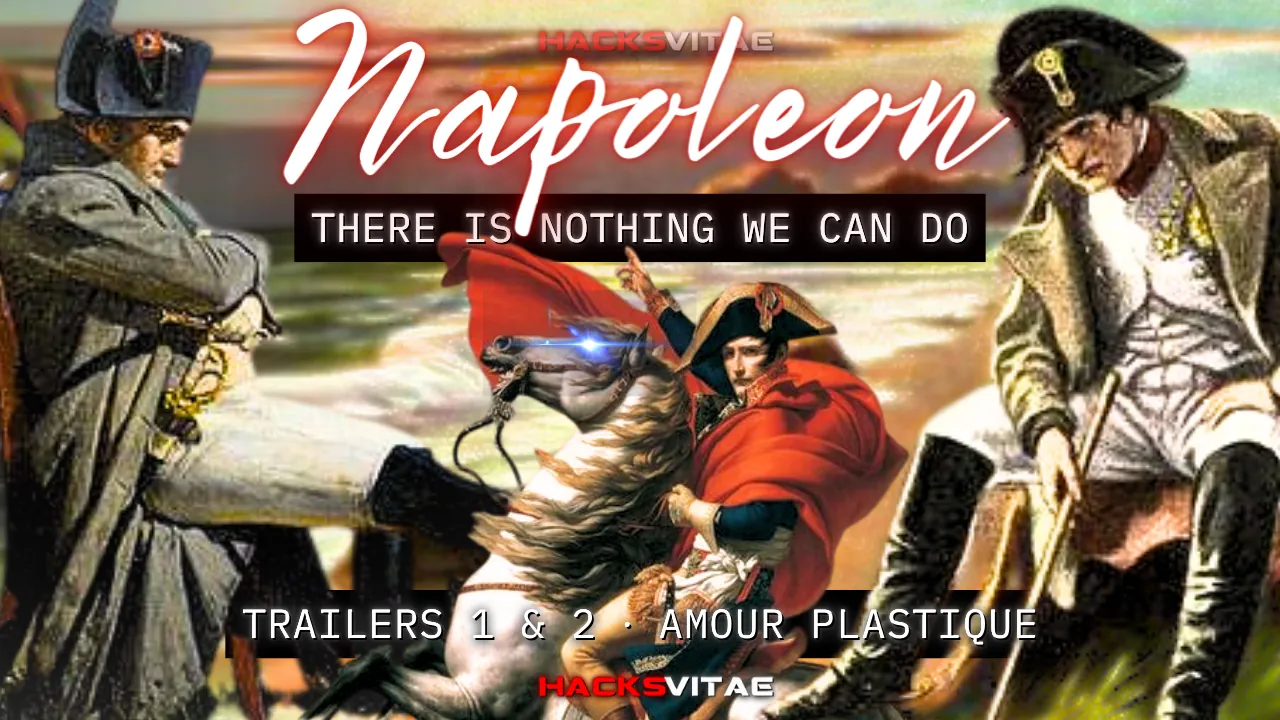
It comes from a TikTok photo slideshow posted on 15 August 2023. Two rage-comic figures, drawn as Napoleon and one of his men exiled on St Helena, trade two lines: “Napoleon, what will we do?” and “There’s nothing we can do.” The slideshow then cuts to paintings of Napoleon on the island, set to a slowed remix of the song “Amour plastique” by Videoclub.
We found no letter, speech or memoir in which Napoleon says it, and the meme never claimed one: it started as dialogue written for two cartoon figures. So the answer to “did Napoleon say it?” is no. The more interesting question is why it stuck to him, and that one has a real answer.
“There is nothing we can do” Meaning
In the meme, the line means resignation. Something is lost, there is no move left, and the only thing to do is stare out to sea. Creators paired it with all kinds of prompts, and much of the joke is the gap between the problem and the gloom.
The pictures matter as much as the words. Most of the images are paintings of Napoleon on St Helena, the island where he spent his last years as a prisoner. That is why the line lands: it borrows the one stretch of his life when he really had run out of moves.
The man himself tells a different story. When a general wrote to tell him something could not be done, Napoleon’s answer went the other way. That letter is below.
“There is nothing we can do.” Meme
The first slideshow drew roughly 1.2 million plays in a month. It was copied by another account on 17 August 2023, but the format only became common in late September 2023. By 21 September 2023 the slowed “Amour plastique” sound behind it had been used in more than 22,600 posts.
Most versions follow the same three steps: a prompt, the line, then a painting of Napoleon looking sad and thoughtful on St Helena.
What Napoleon Wrote About “Impossible”
On 9 July 1813, at Dresden, Napoleon answered a letter from General Lemarois, the governor of Magdeburg. Lemarois had told him that something he wanted done was not possible. The reply, as printed in his collected correspondence:
Vous avez 240,000 boisseaux d’avoine à Magdeburg. « Ce n’est pas possible », m’écrivez-vous : cela n’est pas français. Je suis donc mécontent de votre lettre.
In our translation: “You have 240,000 bushels of oats at Magdeburg. ‘It is not possible,’ you write to me: that is not French. I am therefore displeased with your letter.” He then ordered two boatloads of oats sent at once for the horses of the Guard, “which are dying”.
The saying Impossible n’est pas français (“Impossible is not French”) is commonly linked to this letter. The letter’s own words are longer, and the subject was oats. Still, it is the opposite of the meme: a man refusing to accept “there is nothing we can do” from someone else.
The Rise of Napoleon: Not From Nothing
Napoleon was born in Ajaccio, Corsica, on 15 August 1769. He did not come from humble beginnings. His family’s noble status was officially recognised in September 1771, and that recognition is what let him enter the royal military school at Brienne on 15 May 1779 as a king’s scholar. The school was meant for nobles short of money, and four degrees of nobility were required.
His father, Charles (Carlo) Bonaparte, was elected to the Corsican Estates as a representative of the nobility of the province of Ajaccio in 1771, 1772 and 1777.
From Brienne he went to the École militaire in Paris on 22 October 1784. In the exams of September 1785, 58 of 137 candidates passed and Napoleon came 42nd, commissioned as a second lieutenant in the artillery.
The rest of the rise is well known. He took power in the coup of 18 Brumaire (9 November 1799) and was crowned Emperor of the French in Notre-Dame on 2 December 1804, placing the crown on his own head.
The Fall of Napoleon: A Series of Unfortunate Events
Russia, 1812. In June 1812 nearly 440,000 men were lined up along the Niemen, ready to invade Russia. Counts of what came back differ: the Fondation Napoléon’s preface to his correspondence gives about sixty thousand troops recrossing the Niemen, while World History Encyclopedia says fewer than 100,000 of the 615,000 men committed to the whole campaign returned. The crossing of the Berezina in late November alone cost between 25,000 and 40,000 men. On 5 December Napoleon left the army at Smorgon to return to Paris.
Elba, 1814. He abdicated at Fontainebleau, unconditionally by 6 April 1814, and was sent into exile on the island of Elba.
Waterloo, 1815. On 1 March 1815 he landed at Golfe-Juan, and by 20 March he was back in the Tuileries palace. On 18 June 1815 he was defeated at Waterloo, in Belgium, by the British and Prussian allied armies. He abdicated on 22 June and gave himself up to the British navy.
St Helena: The Real Dead End
This is the part of his life the meme borrows. Napoleon reached St Helena on 15 October 1815. He had already escaped from Elba once, and this time the guard was heavy: the Fondation Napoléon describes the island as “well guarded by three thousand men, and four vessels constantly surveyed its coastline to prevent any landing.”
It was a genuine dead end, and what he did with it is the part the meme leaves out. His days were built around meals, riding and dictating his memoirs to his companions. He had brought more than 600 books with him. He died on St Helena on 5 May 1821, at the age of fifty-one.
Legacy and Impact
The Civil Code. Promulgated on 21 March 1804, the Code civil ran to 2,281 articles. Its property laws swept away feudal traditions, and in France and across continental Europe it fixed ideas such as equality, citizenship, freedom of conscience and the protection of property. It also restored the authority of the husband: a married woman could not perform any legal act or manage her own property without her husband’s agreement.
Slavery. A law of 20 May 1802 provided that slavery would be maintained in the colonies returned to France under the Treaty of Amiens. The Fondation Napoléon calls the re-establishment of slavery, and the repression that followed, a stain on the posterity of the consular regime.
Both belong in the story. The meme is about a lonely man on an island; the record is about a ruler whose laws spread across Europe, for better and for worse.
What to Do With a Quote Like This
A line that goes viral under a famous name can usually be checked in a few minutes. For this one, four questions do it:
- Is there a date and a document? A real quotation comes with a letter, a speech, a book or a recorded conversation. This one comes with a TikTok date and nothing earlier.
- Is there an original-language version? His collected correspondence is in French. An English line with no French behind it is a caption, not a quotation.
- Does finding the words prove the quote? No. His letters contain ordinary phrases such as il ne faut rien faire à présent (“nothing must be done for now”, about a fortified post at the mouth of the Havel, 16 May 1813). Matching words in a different sense is not the same line.
- What did he say on the subject? Here the record gives the opposite: “that is not French”.
The meme is still worth enjoying as a meme. It is a good joke about resignation, and St Helena was a real place where the options ran out. It helps to keep the two apart: the mood belongs to 2023, and the man belongs to the record. For a longer method, see how to spot a fake quote or an invented source, and for the rest of his life, Napoleon Bonaparte: the facts.
Checked September 2026.
Sources
- Know Your Meme, Napoleon “There Is Nothing We Can Do” (origin and spread of the meme, dated entries for August and September 2023).
- Correspondance de Napoléon Ier, vol. 25 (Paris, 1868), letters no. 20014 (to Berthier, Dresden, 16 May 1813) and no. 20256 (to General Lemarois, Dresden, 9 July 1813). Scanned copy, Internet Archive.
- Le Journal du Dimanche, D’où vient l’expression « Impossible n’est pas français » ?.
- World History Encyclopedia, Napoleon Bonaparte and Napoleon’s Invasion of Russia.
- Fondation Napoléon, 1769–1793: Napoleon Bonaparte’s early years.
- Fondation Napoléon, Timeline: Consulate / First French Empire.
- Fondation Napoléon, Preface to volume 12 of the General Correspondence of Napoleon Bonaparte.
- Fondation Napoléon, Napoleon’s Russian campaign: the retreat.
- Fondation Napoléon, From Waterloo to the island of St Helena.
- Fondation Napoléon, The French Civil Code or Code Civil, 21 March 1804: an overview.
- Fondation Napoléon, “Napoleon, the dark side”: Napoleon’s re-establishment of slavery.
- history
- history lessons
- meme
- movie
- movie edit
- napoleon
- napoleon bonaparte