THE ARTICLE · 8 MIN
Ikigai (生き甲斐) is a Japanese word for something that makes life worth living. In Japan it can be people, work or a hobby, and it can be small and private. In the West it has become a four-circle diagram about finding the right career. Those are two different ideas. This page covers both, starting with where the diagram came from, and ends with a few ways to use each.
First: the famous diagram is not Japanese
You have probably seen the four overlapping circles: what you love, what you are good at, what the world needs and what you can be paid for, with ikigai in the middle.
The ikigai version was published on 14 May 2014 by the blogger Marc Winn, in a post called “What is your ikigai?”. In a note added to that post later, Winn writes: “The diagram is not mine. It began as a purpose Venn diagram by the Spanish astrologer Andrés Zuzunaga”. His own part, in his words, was to “add a single word to a shape that already existed.” Zuzunaga, commenting on the same post in 2017, dated his Spanish graphic to 2012.
Winn’s post also pointed readers to Dan Buettner’s TED talk about communities where people live far longer than average.
Ken Mogi, the Japanese neuroscientist who wrote The Little Book of Ikigai, rejects the diagram as a definition. In a talk transcribed by the site Ikigai Tribe in January 2022, he said that “for the western readership, probably this diagram is useful in structuring what motivates you and what gives you pleasure”. But defining ikigai as the overlap of all four circles is, he said, “too narrow of a definition for ikigai”. His example: “if you love to paint a picture, and you’re not paid for that, that is ikigai”. His conclusion: “ultimately, it’s completely wrong. You shouldn’t really take this diagram seriously.”
Why the difference matters
The diagram turns ikigai into a career problem. Two of its four circles are about the market: what the world needs, and what you can be paid for.
In Mogi’s account, neither is required. A hobby that pays nothing can be ikigai, and so can something you are not good at: “you might want to play musical instruments, and you might not play well, but that can also be your ikigai.” He adds that it can be “something vocational”, but that it can also be “your really personal hobby”.
The Japanese government’s English-language magazine describes ikigai the same broad way: “a broad concept, it refers to that which brings value and joy to life: from people, such as one’s children or friends, to activities including work and hobbies.”
Our view is a little gentler than Mogi’s: as he allows, the chart can be useful as a Western career-planning tool, so long as it is not taken as the definition of the word. If your four circles do not overlap, nothing has gone wrong.
What is ikigai?
Meaning and pronunciation
The word joins iki (生き, “life; alive”) and kai (甲斐, “effect”), which is voiced as gai in the compound. The Japanese dictionary Digital Daijisen defines it as 生きるに値するもの。生きていくはりあいや喜び。, roughly “something worth living for; the zest and joy of going on living”.
The Oxford English Dictionary, as quoted on Wikipedia, defines it in English as “a motivating force; something or someone that gives a person a sense of purpose or a reason for living”. The same page gives the English pronunciation as /ˈikiˌɡaɪ/, close to “EE-kee-guy”.
Where the Japanese idea comes from
A classic Japanese book on the subject is 生きがいについて (Ikigai ni tsuite, “On ikigai”) by the psychiatrist Mieko Kamiya, first published in 1966 by Misuzu Shobo. Kamiya worked as a psychiatrist at Nagashima Aiseien from 1957 to 1972; Wikipedia describes it as a sanatorium where she treated leprosy patients. Her publisher’s page opens with her question: what is it that makes our everyday life feel worth living, and once a person has lost their ikigai, how do they find a new one?
Ken Mogi’s five pillars
Mogi’s The Little Book of Ikigai went on sale on 7 September 2017, according to its publisher, Quercus; in the United States it is titled Awakening Your Ikigai. It sets out five pillars: starting small, releasing yourself, harmony and sustainability, the joy of little things, and being in the here and now. None of them is about money or a career. Summarised from Ikigai Tribe’s write-up of its interview with Mogi:
- Starting small. Mogi links it to kodawari, “an approach where craftspeople take extraordinary care of the fine details of their work”.
- Releasing yourself. Accepting who you are. The book puts it this way: “accepting yourself is one of the most important and difficult tasks we face in our lives.”
- Harmony and sustainability. Getting on with other people and thinking about the wider effect of what you do: “you should show adequate consideration for other people and be mindful of the impact your actions might have on society at large.”
- The joy of little things. Small pleasures built into the day; Mogi’s example is having favourite things, such as chocolate and coffee, soon after you get up.
- Being in the here and now. Mogi’s point is that children value the present because they have no definite idea of the past or future.
How to find your ikigai
It depends which ikigai you mean.
The Japanese sense is rarely worked out on paper. In Mogi’s account, Japanese people are aware of the idea from childhood, and “we don’t actually discuss ikigai in expressed, rule-based, algorithmic ways.” The publisher’s description of Mogi’s book gives three people who each have one: “a cleaner of the famous shinkansen bullet train, the mother of a newborn child or a michelin-starred sushi chef.”
The Western diagram is a set of career questions. Where two circles overlap, the usual version adds a label: passion, mission, vocation and profession. The labels were already attached to it by 2015, when a commenter on Winn’s post asked where “the passion, mission, vocation, profession visual model” came from.
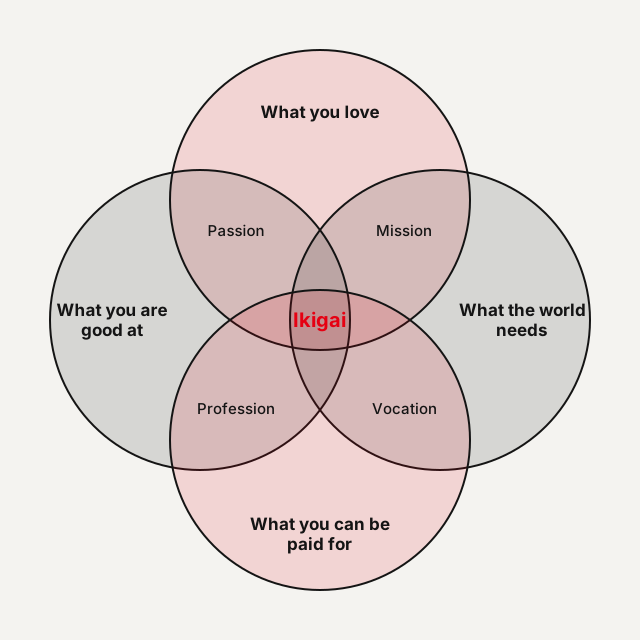
The four questions are:
- What do you love?
- What are you good at?
- What does the world need?
- What can you be paid for?
Used this way, the four questions are a starting point for thinking, not a measurement of anything.
How to apply ikigai in work and in life
The two ideas lead to different uses.
In life, the Japanese sense asks less of you. Mogi calls ikigai “a really wide spectrum of things that you love to do”, so you can have more than one, and they can be small: people, a craft, a routine. Mogi’s pillars describe a way of holding them: start with details, accept yourself, fit in with the people around you, notice small pleasures, and pay attention to the present.
In work, the diagram is a way of testing a job or a plan against four questions at once. If a job pays but you do not care about it, or you love something nobody pays for, the chart shows where the gap is. What it does not show is whether your life has meaning. In Mogi’s account, that can sit entirely outside work.
Examples of ikigai
The Japanese government’s 2022 article on ikigai visited Ogimi village in Okinawa, which it calls “a ‘village of longevity’”. Among the older residents it describes:
- Taira Toshiko, described as a 101-year-old textile artisan who “has been making bashofu, a traditional fabric, for many years”, and who was designated a Living National Treasure of Japan in 2000 for preserving the craft.
- Tedokon Keiki, described as 91 years old and still growing crops.
The same article reports that Héctor García, co-author of Ikigai: The Japanese Secret to a Long and Happy Life, interviewed “more than 100 elderly residents” of Ogimi for the book.
Mogi’s own examples are just as ordinary: painting a picture nobody pays for, or playing a musical instrument badly and loving it.
What you can do with this
- Keep the two ideas apart. A list of what makes an ordinary day worth it is one exercise. A career plan tested against four circles is another. Both can be useful; mixing them makes the first feel like a failed version of the second.
- Count unpaid things. On Mogi’s account, a hobby that earns nothing, or a skill you have not mastered, can still be ikigai.
- Allow more than one. The Japanese government’s description covers people as well as activities, and work as well as hobbies.
- Use the diagram as a check on work, not a test of a life. It is a 2014 adaptation of a purpose diagram, and it is good at showing where a job and your interests do not meet.
Sources
- Marc Winn, “What is your ikigai?”, The View Inside Me (14 May 2014, with a later note and reader comments, including one from Andrés Zuzunaga).
- Ikigai Tribe, “Ken Mogi on what makes the Ikigai Venn Diagram wrong” (26 January 2022), transcript of Mogi’s talk.
- Ikigai Tribe, “Interview with Ken Mogi on the 5 Pillars of Ikigai” (podcast episode page).
- Hachette India (Quercus), The Little Book of Ikigai by Ken Mogi: publisher’s description; Quercus Books, ebook edition page (on-sale date).
- The Government of Japan (JapanGov), “Ikigai: The Japanese Secret to a Joyful Life”, Kizuna (2022).
- Digital Daijisen (Shogakukan), “生き甲斐”, via Kotobank.
- Wikipedia, “Ikigai” (for the OED definition, pronunciation and etymology).
- Misuzu Shobo, book page for 生きがいについて and author page for 神谷美恵子.
Checked September 2026. The diagram’s history is taken from Winn’s own post and note; Mogi’s views from the transcript of his talk; the pillars from Mogi’s publisher and Ikigai Tribe’s interview write-up. We did not read The Little Book of Ikigai itself, so the book’s lines above are as quoted by Ikigai Tribe.
- life
- philosophy of life
- purpose and fulfillment
- self development
- self help