THE ARTICLE · 7 MIN
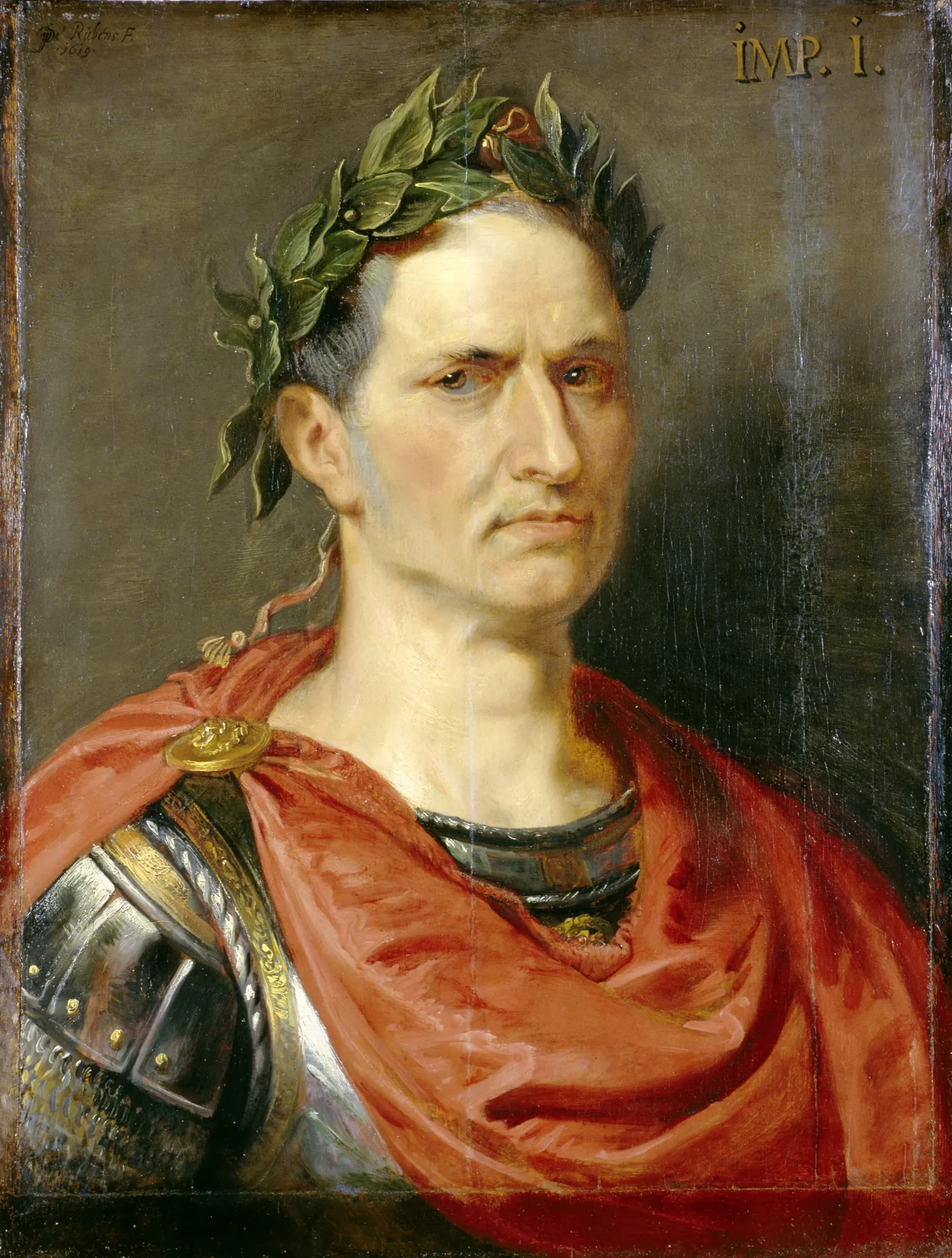
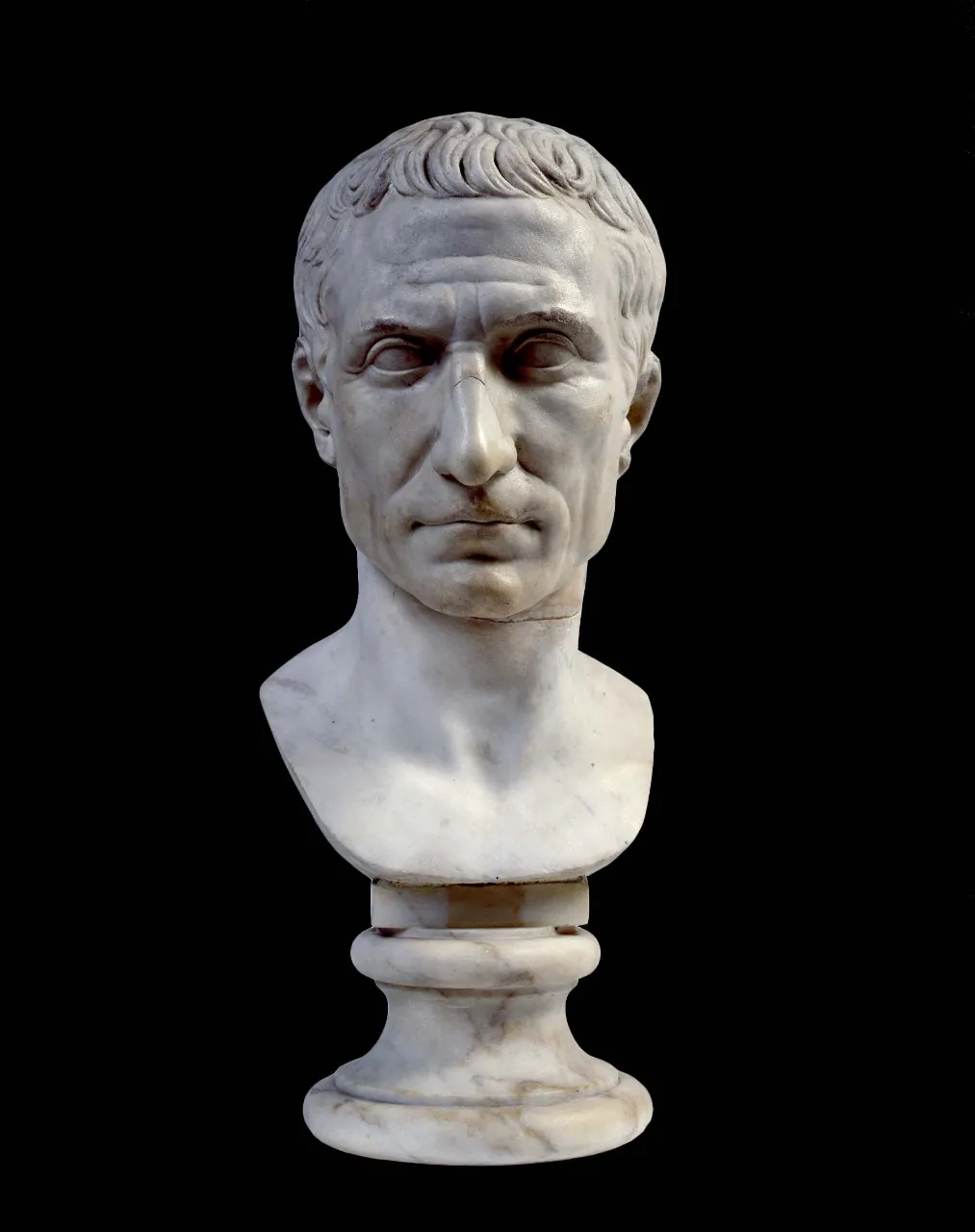
Gaius Julius Caesar conquered Gaul, won a civil war, made himself dictator for life, and was stabbed to death by a group of senators on the Ides of March, 44 BC. He was never a Roman emperor: Rome was still a republic, and the first emperor was his adopted heir, Augustus. This page covers his life in brief, the lines people quote (and who really wrote them), and what his rise and fall can teach.
GAIUS JULIUS CAESAR SUMMARY
Caesar was born in July 100 BC in Rome. That is the date most modern accounts give, though Britannica marks the year with a question mark; its 1911 edition, following the historian Theodor Mommsen, preferred 102 BC. The ancient biographers agree on his age at death: Suetonius says he “died in the fifty-sixth year of his age”.
His family was patrician, one of Rome’s old noble houses, and claimed descent from Iulus, son of Aeneas and grandson of the goddess Venus.
RISE TO POWER: CONQUEST OF GAUL
Between 58 and 50 BC Caesar conquered the rest of Gaul up to the left bank of the Rhine. He wrote his own account of the campaigns, the Commentaries on the Gallic War.
“I am not much in fear of these fat, long-haired fellows, but rather of those pale, thin ones.” — Caesar, as reported by Plutarch (Caesar 62, Bernadotte Perrin’s translation), meaning Brutus and Cassius
CIVIL WAR
In January 49 BC Caesar crossed the Rubicon, the river that separated Cisalpine Gaul from the rest of Italy, with a single legion, and began a civil war against Pompey. Plutarch describes him stopping at the river and wavering for a long time before crossing with the phrase “Let the die be cast”; Suetonius gives it as “The die is cast.”
The civil war ran from 49 to 45 BC and ended with his victory over Pompey’s sons at Munda, in Spain, on 17 March 45 BC. In 47 BC, in the middle of it, he beat Pharnaces, son of Mithridates the Great, at Zela so quickly that he summed it up in three words: veni, vidi, vici.
The Romans then appointed him dictator for life. Plutarch is blunt: “This was confessedly a tyranny, since the monarchy, besides the element of irresponsibility, now took on that of permanence.”
FALL: ASSASSINATION ∙ TRAGIC DEATH
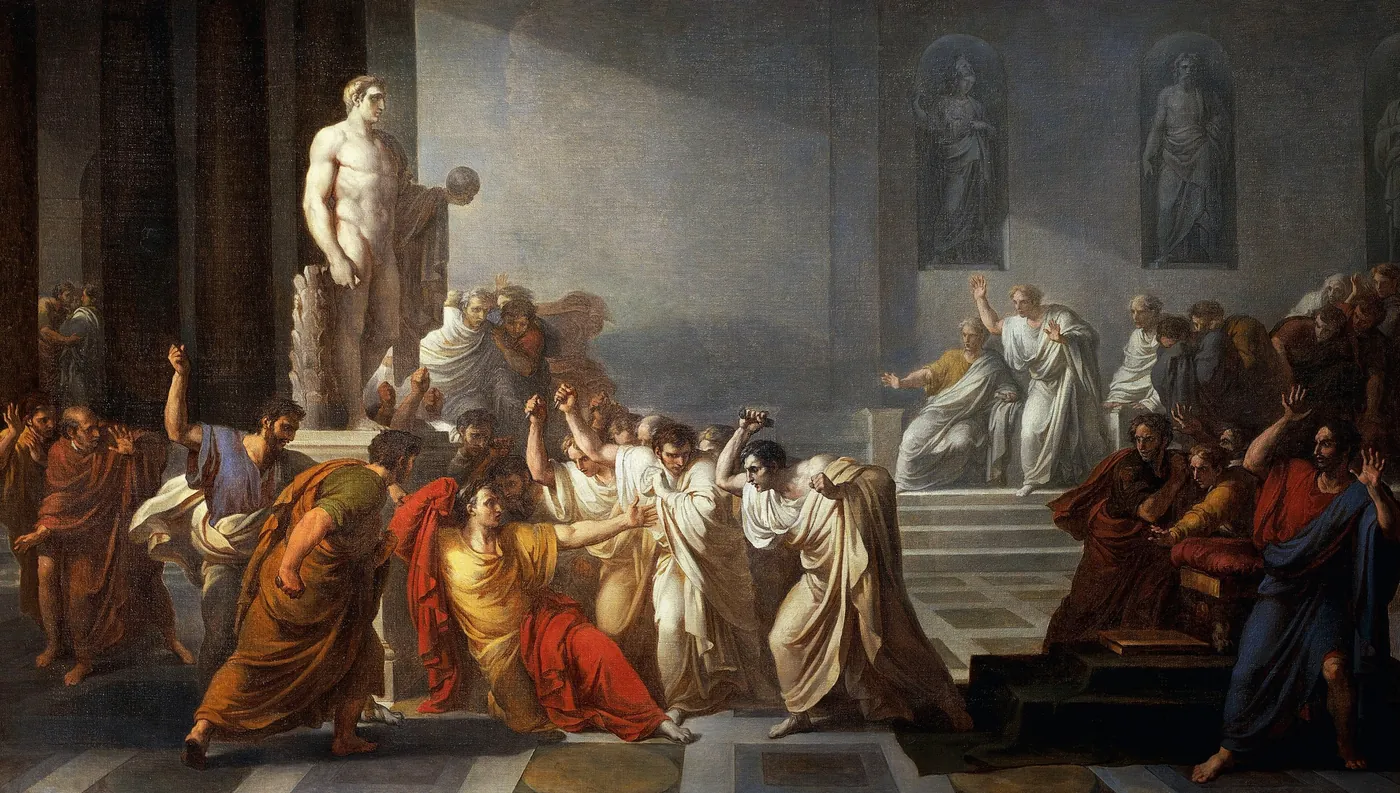
More than sixty men joined the conspiracy, led by Gaius Cassius and by Marcus and Decimus Brutus. They chose a meeting of the Senate called for the Ides of March in the Hall of Pompey. Caesar died on 15 March 44 BC, stabbed with twenty-three wounds.
Both biographers record a warning. Plutarch writes that “a certain seer warned Caesar to be on his guard against a great peril” on the Ides of March; Suetonius names him as Spurinna. On the day, Caesar joked that the Ides had come, and the seer answered, in Plutarch’s version: “Ay, they are come, but they are not gone.”
Killing him did not end the fighting. Suetonius notes that hardly any of the assassins survived Caesar by more than three years. In his will Caesar had adopted his great-nephew Gaius Octavius, and it was Octavius who came out on top: in January 27 BC the Senate gave him the title Augustus (on the 16th, according to two surviving Roman calendars; on the 17th, according to the later writer Censorinus), and he is counted as the first of the Roman emperors.
“Beware the ides of March.” — the Soothsayer, in Shakespeare’s Julius Caesar, I.ii. Caesar is the one being warned; the famous wording is Shakespeare’s.
GAIUS JULIUS CAESAR QUOTES
Several of the most quoted lines credited to Caesar are best known from Shakespeare, not from Caesar. Here is where the familiar ones come from.
True as reported. “I came, I saw, I conquered” (veni, vidi, vici). After Zela in 47 BC. Plutarch says Caesar wrote the three words to a friend at Rome, Amantius; Suetonius says they were carried on an inscription in his Pontic triumph, “not indicating the events of the war, as the others did, but the speed with which it was finished.” There is more on the phrase in our page on the Veni Vidi Vici method, where the “method” is this site’s own framework, not Caesar’s.
True “Experience is the teacher of all things.” This is Caesar’s own writing, Civil War 2.8: ut est rerum omnium magister usus. It is an aside in his account of a siege, where the soldiers found by experience that their small brick shelter would be more useful raised into a tower. It is not a free-standing motto.
True “Men willingly believe what they wish.” Caesar, Gallic War 3.18: fere libenter homines id quod volunt credunt. W. A. McDevitte’s translation reads “in most cases men willingly believe what they wish”. He is explaining why an enemy fell for a trick.
True as reported. “I would rather be first here than second at Rome.” Plutarch (Caesar 11) says Caesar said it while crossing the Alps and passing a poor village.
Fiction “Et tu, Brute?” The famous version is Shakespeare’s (Julius Caesar, III.i: “Et tu, Brute! Then fall, Caesar.”), and the Latin phrase was already familiar on the English stage in his day: The True Tragedie of Richard Duke of York, printed in 1595, has “Et tu, Brute? wilt thou stab Cæsar too?”. No ancient source gives Caesar these words. Suetonius says Caesar died “uttering not a word, but merely a groan at the first stroke, though some have written that when Marcus Brutus rushed at him, he said in Greek, ‘You too, my child?’”
Fiction “Let me have men about me that are fat.” Shakespeare’s version (I.ii) of the line Plutarch reports about “pale, thin” men.
More at: Gaius Julius Caesar Quotes ∙ Words of Wisdom
GAIUS JULIUS CAESAR LIFE LESSONS
These are our readings of his life, not rules he left behind. Each one rests on something the sources record.
Speed can be the message
Suetonius says the three words of veni, vidi, vici were chosen to show “the speed with which it was finished”, not the events of the war. What he wanted remembered was how fast it was done.
Big decisions are rarely as bold as they look afterwards
“The die is cast” sounds like instant resolve. Plutarch’s account is slower: Caesar stopped at the Rubicon and “communed with himself a long time in silence as his resolution wavered back and forth” before he crossed. The famous line came at the end of the doubt, not instead of it.
Words change how people act
Suetonius says Caesar addressed his soldiers “not as ‘soldiers,’ but by the more flattering term ‘comrades’.” When the Tenth legion demanded their discharge, “with a single word, calling them ‘citizens,’ instead of ‘soldiers,’ he easily brought them round”, and they insisted on following him to Africa. One word told them what they would be giving up.
Mercy won loyalty, and did not protect him
Caesar was known for sparing enemies. Plutarch says “he pardoned many of those who had fought against him, and to some he even gave honours and offices besides, as to Brutus and Cassius”. Suetonius adds that at Pharsalus he cried out, “Spare your fellow citizens.” Two of the men he pardoned and promoted led the plot to kill him.
Power without limits made enemies
Plutarch calls the dictatorship for life “confessedly a tyranny” because it added permanence to power that already answered to no one. Suetonius reports that some thought Caesar trusted the senators’ oath so fully “that he dismissed even the armed bodyguard of Spanish soldiers that formerly attended him”. His rise shows what drive and speed can do; his fall shows what happens when nobody can check a leader’s power, including the leader himself.
GAIUS JULIUS CAESAR LEADERSHIP IN TODAY’S WORLD
A few ways to put the lessons above to use, whether you lead a team or just your own week:
- Say what the result was, briefly. Three words carried Zela. A short, plain report of what got done often lands better than a long one.
- Let the doubt happen before the leap. Caesar’s pause at the Rubicon is part of the story. Taking time to think before a big, hard-to-reverse choice is not the opposite of decisiveness.
- Pick your words for the people in front of you. “Comrades” and “citizens” did more than a speech. Notice what the words you use tell people about where they stand.
- Be generous, and still keep your eyes open. Pardoning opponents won Caesar support. It did not mean every pardoned opponent was a friend.
- Build in checks on your own power. The lesson of the Ides of March is less about enemies than about a man nobody could say no to.
Sources
- Plutarch, Life of Caesar, trans. Bernadotte Perrin (Loeb Classical Library), LacusCurtius: chapters 11, 32, 50, 57, 62, 63, 69.
- Suetonius, Life of Julius Caesar, trans. J. C. Rolfe (Loeb Classical Library), LacusCurtius: chapters 32, 37, 67, 70, 75, 80–83, 86, 88, 89.
- Caesar, Gallic War 3.18 and Civil War 2.8, Latin text at The Latin Library; Gallic War trans. W. A. McDevitte, Project Gutenberg #10657.
- William Shakespeare, Julius Caesar, MIT Shakespeare text: I.ii, III.i.
- Julius Caesar, ed. E. C. Black (New Hudson Shakespeare), introduction, “Et tu, Brute”, Project Gutenberg #28334.
- The Roman calendars (fasti) for 16 January, in Ehrenberg and Jones’s translation (attalus.org); Censorinus, De die natali 21.8, Latin text at LacusCurtius.
- Encyclopaedia Britannica, “Julius Caesar” (read in a browser; the site blocks scripts).
- Encyclopaedia Britannica, 11th edition (1911), “Caesar, Gaius Julius” and “Augustus”, Wikisource.
Checked September 2026. Dates, the assassination and the quotations were read in the ancient sources above and in the two editions of Britannica. If you can show any of this wrong, with a source, we want to see it.
- leadership
- life
- life lessons
- philosophy of life
- quotes
- relationships
- self development
- self help
- summary
- values